
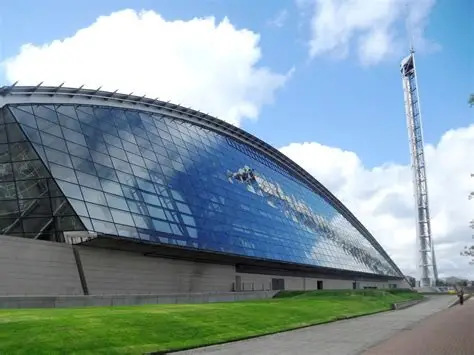
Last week I went along to the Climate Emergency Summit at Glasgow Science Centre. I suppose I wasn’t expecting to hear about how great everything is, but the mixture of mild complacency alongside messages of imminent doom still proved somewhat jarring. In the spirit of the Open Working and Reuse programme, I made a few notes, and also live-tweeted throughout the event — more on that later.

I work at an anti-racist charity that promotes environmental work in ethnic minority communities, so perhaps my first observation will be an obvious one — this was a very white event. I mean, this was like being at a Kaiser Chiefs gig.
You have to give Holyrood Events (the organisers) their due, in that as far as I could see 40% of the visible ethnic minorities attending over the two days were speakers. As in two of us, out of five. My eyesight isn’t great, but I spotted one other delegate, a poor guy staffing the Drax stand who I imagine had a few tough questions to answer, and the two speakers. That suggests to me that while the organisers are attuned to the sensitivities around representation, the audience hasn’t quite caught up yet.
This was especially interesting as one of the “hot topics” was around Loss & Damages — with Jim Curran, chair of day 2, suggesting that L&D might be a distraction from the “real work,” while Michael Matheson MSP proudly declared that SNP policy was leading the way. I suppose the fact that we were talking about it was progress of sorts.
Back to the live tweeting. I thought I was perhaps a bit late to the party with this, but in fact there were not many other people out there engaging on social media (shout out to Rebecca Wade who was tweeting throughout). It was interesting to see a good level of engagement however, which led to me being followed by a few of your actual, bona fide journalists. That was a surprise to me, as I’d imagined I’d been talking to myself.
The main event was probably Chris Stark, Chief Exec of the Committee on Climate Change, who closed day one. Some bullet points from him included:
- Scotland isn’t on track for net zero by 2045, let alone 2030. Any attempt to suggest we are, is a “collective example of magical thinking.”
- The Climate Change Act has “lost its integrity,” with any steps forward being entirely attributable to Covid lockdowns, and the discourse still stuck in arguments around wind farms.
- Almost all reductions need to happen outwith the power sector — so here’s looking at you, transport, farming and building.
- It still all comes back to fossil fuels, and in nearly every sector we are going backwards, not forwards. There are huge skills shortages in the areas we need to change.
BUT…
- If Scotland can’t do it, nowhere can — so it’s important we do it!
- Some low-hanging fruit remains — e.g. we could save £34M just if people closed their curtains at night. Little appetite in government for “nanny state” public information campaigns, however.
- In Scotland, sites like Grangemouth could actually be an asset — a single area which can be tackled comprehensively, rather than a disparate, geographically complex system.
SO…
- Coordination and cooperation are now the key, and that most rare of superpowers — joined up thinking.
- The Paris COP showed that multilateralism can work.
- Scotland can be a global template.
As I say — a mixture of eye-watering doom and gloom, but with some notes for cautious optimism thrown in.
It was a great two days, and thanks to Holyrood again for organising. When I attend the next one, will people still be saying “what we need now is action, not more talk?” Or will the “action” actually have started?